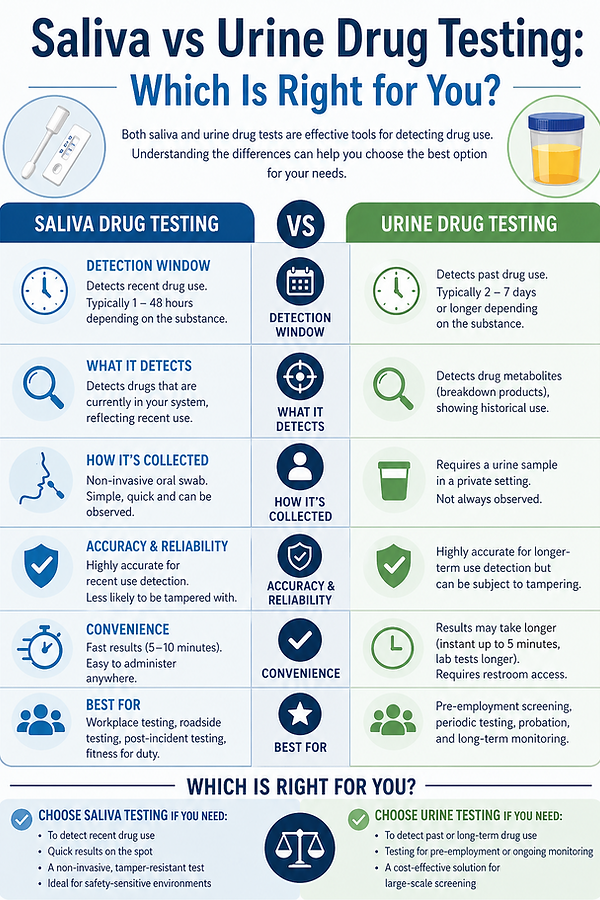
Saliva vs Urine Drug Testing: Which Is Right for You?
Drug testing is essential for maintaining a safe and compliant workplace, especially in industries where alertness, decision-making, and safety are critical. Two of the most commonly used testing methods in Australia are saliva drug tests and urine drug tests. While both provide fast and reliable results, they serve different purposes and are better suited for specific situations.
​
In this guide, we break down the key differences between saliva and urine testing—and help you decide which method is right for your workplace or organisation.
​
What Is Saliva Drug Testing?
Saliva (oral fluid) drug testing detects recent drug use by analysing a small amount of saliva collected from the mouth. This method is increasingly popular in Australia due to its simplicity and ability to detect impairment.
​
Advantages
-
Detects recent use (within minutes to hours)
-
Non-invasive and easy to supervise
-
Harder to adulterate or cheat
-
On-site results in minutes
-
Ideal for post-incident, and for-cause testing.
​
Detection Window
Typically up to 24–48 hours, depending on the substance.
Common Uses
-
Transport and logistics
-
Mining and construction
-
Random workplace testing
-
Safety-critical environments
​
What Is Urine Drug Testing?
Urine drug testing identifies drug metabolites, which stay in the body longer than in saliva. It is the most widely used and cost-effective method for screening.
​
Advantages
-
Longer detection window (2–7 days for most drugs; longer for cannabis)
-
Lower cost per test
-
AS/NZS 4308:2023 compliance available
-
Can detect a broader range of substances
​
Detection Window
Typically 2–7 days, depending on the drug and frequency of use.
Common Uses
-
Pre-employment screening
-
Return-to-work programs
-
Rehabilitation monitoring
-
Routine compliance testing
​
When Should You Use Saliva Testing?
Saliva drug testing is the better choice when you need to know if someone is currently impaired or has used recently.
​
Use saliva testing when:
-
Conducting random onsite testing
-
Investigating post-incident situations
-
Testing employees in safety-sensitive roles
-
You need fast, observable, no-fuss collection
-
You want to reduce the risk of tampering​
​
Many Australian workplaces in transport, mining, and construction have saliva testing as their primary method for these reasons.
​
When Should You Use Urine Testing?
Urine drug tests are best when your priority is detecting patterns of drug use over time.
​
Use urine testing when:
-
Screening pre-employment candidates
-
Monitoring individuals under return-to-work arrangements
-
You need a broader detection window
-
Conducting periodic compliance testing
-
You require AS/NZS 4308:2023 laboratory confirmation
It’s also more cost-effective for high-volume testing programs.
​
Which Method Is Right for Your Workplace?
The right choice depends on your goals:
-
Choose saliva testing if you want to detect recent use and ensure staff are fit for duty right now.
-
Choose urine testing if you need to identify historical or ongoing drug use, or if you’re screening new staff.​
​
Many Australian employers use both, depending on the scenario—for example, saliva for random daily testing and urine for pre-employment.
​
Final Thoughts
Both saliva and urine drug testing play important roles in maintaining a safe, drug-free workplace. Understanding the differences helps you choose the right tool for your policies, industry, and risk profile.
If you need rapid drug testing kits, explore our full range at rapiddrugtests.com.au—we supply high-quality, compliant saliva and urine tests for workplaces across Australia.
​
Disclaimer.
​
The information provided in this article is for general educational purposes only and is not intended to constitute legal, medical, or professional advice. While every effort has been made to ensure the accuracy of the content at the time of publication, regulations, standards, and best practices may change. Employers and individuals should always refer to the appropriate Australian Standards, workplace policies, and relevant legislation, and seek independent professional advice when implementing drug and alcohol testing programs. rapiddrugtests.com.au accepts no liability for any loss or damage arising from reliance on the information provided.